Saturday, February 2, 2013

Nostalgia

The other day I was doing the usual facebook crawl, and clicked on someone's page where they had their location identified on a map.  Just happened to have been in Mexico City, the place where I grew up. 
I was curious to see where this was in relation to where I lived.  Lo and behold, the map's Google now provides extend city views to - seemingly - all areas around the world!  When I had tried to find this several years back, was not there.  I spent the next hours happily clicking around, being a virtual tour to many of my old stomping grounds.  Amazing how even 30-40 years later, the memories and recollections are still there. 

Here is the home we lived in during the last 4-5 years I was there.

For those of you who have not lived in Mexico City - you will see that this (and all homes in the city) are well fenced off - likely due to the crime rate. The doorbell usually is at the outer fence, and you get to talk to the person to see if you care to buzz them in the door.  Sadly you can't see inside, although I am sure there is not much to see anyhow. 
Right above the number "412", you can just barely see a window.  This was my room.  It really was a small library - but growing up with 5 (6 if you count Barbie!) sisters, I was given my own room - so it was converted.  Below that was a shaded area that had a nice garden.  Then I got 2 rabbits and fenced them in the area.  They soon grew fairly wild and tore up the entire area.  Dad finally had enough of them at some point, so we rounded them up and released them in the wild.  While today I am pretty sure they lived short lives and then were likely some other animals' meal, in those days I was appeased - thinking they would live free and happy lives.  Oh the joy of a child's naivete.

On then left side of the house, all the rooms on both floors, had floor to ceiling windows.  The second story had a common balcony across the entire length of the home.  My childhood friend Lee and I would always jump off this balcony (and off the fences in his home as well).  How we did not hurt ourselves, and how my parents did not disallow this, I will never know.  One of our more "brilliant" dogs, Daphne (Daffy for short), also fell off the balcony.  She recovered, but it took quite some time.  Oh, and I seem to remember that she too ran down the wooden stairs, sliding off them and through yet another floor to ceiling window pane.  Amazingly was not hurt.  We joked about this dog's 9 lives.

Well - enough reminiscing for one day.  More later though :-)

Saturday, December 29, 2012

Second Chances

I don't usually post about me.  Or rather, I post often about things I find interesting. 
While my vast readership would challenge my opinion on interesting - I infrequently persevere :-)

   
Today is our anniversary.
We have spent the last dozen years blissfully together.
Every day and especially on this one, I choose Holly.
Again and again...

If I could muster up the grumpiness to find anything to regret, it is that we will not have long enough lives to likely celebrate a 40, 50 or 60 year anniversary.

But I digress.


Life can be hard.  Anyone who lives it recognizes that.  Now compared to many, mine has been rather charmed.  Even so, mistakes were made, and I found myself at almost 40 without a life partner.  Without someone to share the highs and lows of life.  To have and to hold. 

In retrospect, it is clear that I met Holly just at the right time.  The life experiences I went through were the best teacher.  Showing me clearly who I am and what I desired out of life.  I am not saying that had we met another time in our lives that we would not have ended up together.  I am pretty sure that some things are just meant to be.  But it took a failed first chance to prepare me for the miracle of Holly. For those that don't know her, it is your loss.  She is an amazing woman, who quietly shines her beautiful light on her small corner of the world.  As far as second chances go, this was the granddaddy of them all. 


In the beginnings of us, we spent a couple days on Catalina Island.  One of the places I remember well was Two Harbors.  An isthmus of land separating two beautiful harbors.  I enjoy analogies, and felt as if each of us were the harbors, and finally discovering each other, bridging the narrow gap that had kept us apart. 


Discovery was short.  Like 2 puzzle pieces we fell into each other easily and snugly. 
Life may continue to be hard, but having Holly in my life ads a sweetness and joy to everything. 
I can't imagine life without her.  She is my true North.  The place I call home. 

It IS a Happy Anniversary indeed.

Tuesday, December 11, 2012

Moore & Rose

How many of you are familiar with Moore's Law?  Probably most if you have any geek about you :-)

For those who don't know, Moore's Law (circa 1965) is the observation that over the history of computing hardware, the number of transistors on integrated circuits doubles approximately every two years.   That just happens to align strongly with processing speed and memory capacity. 
So we can thank Moore's law for predicting the fancy computers we own today.
Actually - the law was originally thought to likely run its course within around 10 years.  Quite impressively, it remains true today as well!

So who is Rose?  And what is Rose's Law?  That would be Geordie Rose, who observed a very similar trend for Qubits. 
What - you ask - are qubits?  It is a made up word, a word made from the joining of "Quantum" and "bit".   Bits in the traditional digital world are binary representations, a 0 or a 1, True or False, On of Off.  Take your pick.  The key is they can take on one of two distinct values.  Nearly every modern computer works in this digital world, and quite successfully too.  Qubits can have many discrete states at the same time.  It can be a 0 and a 1 at the same time!  Part of the magic of the quantum world's weirdness.

So back to bits and qubits.  Moore used the following meager set of 5 data points to discover his law.

Rose has used the following to derive his Law:


Both represent an exponential growth in linear terms.  The difference... and this is key - it that a doubling in transistor density represents a doubling in processing power.   A doubling of Qubits represents an EXPONENTIAL growth. 
Without going very far out in the future - this could mean that in 1 or 2 years, a quantum computer will be faster than the fastest computer we have today. 
Give it another 1 or 2 years, and ONE quantum computer will be faster than all the computers on earth combined. 
Give it another 1 or 2 years, and it could conceivably be faster than the entire universe! 
Mind you, I don't even know what that last one really means.  But if it does not sound a bit scary to you, you have not watched enough science fiction!
How can it do this?  Quoting from David Deutsch, "it harnesses the refractive echoes of many trillions of parallel universes to perform a computation". 

I for one, will welcome our Robot overlords :-)


PS - neither Moore nor Rose named their laws... neither owned an ego that large. 


Sunday, November 25, 2012

The Ultimate Sales Job

We don't have a newspaper delivered, much to the dismay of our local paper the Rockford Register Star and some of my friends and family. Even so, today they delivered us a free Sunday newspaper. As I opened it up before throwing it in the recycling bin, I was surprised to see that of the maybe 50-60 pages, we just might have 5-6 pages of actual news. The rest? Advertising.
And having just come back from a Thanksgiving holiday in Houston, the ratio was even worse.

I also went to see a movie with my family. "The Life of Pi".  It was well done and thought provoking.  But I digress.  Before we could enjoy the movie, we had to wade through 20 minutes of advertising.  Not for other movies - but for cars, perfume, furniture, dish detergent and all manner of things I usually take pains to not subject myself to.
And as I scan magazines, I suspect the content to advertisement ratio is similarly diminutive.
Thankfully we record all of our TV, so we can skip the story disruptions nicely.
Looking over the football college bowls... they are no longer the sugar & orange bowls, they are the Allstate & Discover bowls and played in the Mercedes-Benz Super dome & Sun Life Stadiums.

I could go on, but I think the point is clear.  Advertising is everywhere. 

But here is the rub.  What do ALL of these things have in common?  We already payed for them.  Newspapers, magazines, movies, sports, cable TV.   
We have gone from advertisement despising folk to ones who now shell out a pretty penny to have these media and entertainment providers shove it down our throats. 
In an insidiously perverse way, I have to give them kudos.  I would not have thought this possible 20 years ago.

Sunday, November 11, 2012

You a Pansy? Take hope.

If I called you a pansy, you would be, rightfully, insulted. 
Assuming of course, you cared about my opinion. 

Even so, I have to wonder about the term.  It is mid November.  Every potted plant we cared for meticulously through Spring, Summer, and now Autumn, has died and gone to plant heaven.  Par for the course and expected.  With one exception.   A most resilient little plant, pictured here.


We don't water it anymore.  We have not brought the plant in from the heat or cold.  And yet here it is, the last survivor from a brutally hot 2012 Summer.  Not just alive, but blooming vigorously.
 
So the next time you think to call someone a pansy, you may wish to rethink your choice of words!


Tuesday, October 30, 2012

Climate Change & Sandy


If you have not heard about Climate Change - you are to be congratulated. That level of isolation is truly hard to come by... you will probably live longer and happier than most of us :-)

If you have - I am sure it is also not news to you that the topic makes a resurgence in the headlines every time a weather event such as Sandy occurs.  Those who feel it is important to proselytize the masses with their concern can point to such events and say "See... Climate Change... we told you so".  And those who for various reasons choose to remain skeptical of the science discount these events as nothing more than the natural variation endemic to weather.

For me?  For once I would say they are both right, or wrong - take your pick.
Here is how I build an analogy - simplistic as it may be.

Suppose you are playing a game of dice.  You pick.  Also assume that someone has loaded the dice in such a way that the odds of hitting snake eyes is a little higher.  Let's even assume that you know the dice are loaded.  First off, I am pretty sure that if in the game you are playing snake eyes is not a good roll, you will not want to be the player using them!  But for argument sake, you do. 
Do you claim then, that every snake eyes you roll is a direct result of the dice being loaded?  Of course not.  That is just silliness.  But over time, with careful bookkeeping - you will see more of them than if you had fair dice. 
Climate change is similar.  A warming planet loads the weather dice.  To point to any one weather event and claim it is a direct result of climate change is wrong headed - and is really a misrepresentation of how climate change works.  This weather event is just one roll of the dice. 


Friday, October 12, 2012

The Gas Price Lie

I am fact checker.  Those who know me understand my positions are data driven (mostly). 
Which is one of the reasons I so enjoy many of the fact checking sites that have pervaded the internet over the last decade.

But I was sorely let down last week when I read FactCheck's "Obama's Numbers".

Lots of information there.  I have not verified most of it - but a quick perusal showed one that seemed glaringly wrong.  Specifically that gas prices have risen 106% under Obama's term thus far.
Now mind you, I honestly don't think presidents have much say or impact on the matter.  But we know that in the weeks leading up to the election, lots of misinformation (a.k.a lies) are thrown around by both parties. 
And this one particularly irks me.  Why?  Because it is such a straightforward check that can be so easily dismissed!   So how did FactCheck miss this as well?  Let's take a look.
This represents the last 8 years of average gas prices.  You will notice that right around when Bush left office, we had radically low gas prices.  Between $1.60 and $1.80 a gallon.  Current prices are now in the mid to upper $3 dollars.  Using these 2 points - we get the numbers FactCheck generated. 

We could end the story there, but should not.  Taking the data and running the numbers, we get that during Bush's first term prices averaged $1.66 / gallon.  During Bush's second term prices averaged $2.91 / gallon.  A nice 75% price increase.  During Obama's term thus far, prices averaged $3.13 /gallon.  A reasonable 7-8% price increase.

So the next time someone lies to you about this - call them out.  Embarrass them for parroting bad information.  If they are sticking to the party line - and insist on their cherry picked number - remind them that the only reason prices were as low on Bush's exit was because we had a global economic meltdown.  I am surprised they want to use that to their credit.

Sunday, August 14, 2011

My Political Party

Unless you have been hiding under a rock, it should be apparent to all that the political process in the USA seems to be FUBAR.  Those who know me know I lean a little left.  Even so, I am greatly disappointed with the Democratic Party, and appalled by the Republican Party.  As I view the Tea Party as the more fanatical segment of the Republican Party, I think you can guess my opinion :-)
I have often thought if myself as Independent - but have not considered this a viable voting strategy.
Before I say more - know that I will never vote straight party ticket.  Abdication of ones mind is the last thing we need these days!

So I have been thinking... what platform would a political party have to have to get my overall support?  Here is my radical list:
  1. Candidate pledges to serve ONLY one term. 
  2. Candidate will not take any contributions from anyone but individuals, and will adhere to strict contribution limits (No Corporations, Unions, PACs, Religious groups, etc.)
  3. Candidate will only air ads that talk about their own platform, and will refuse to endorse any ads not part of their campaign
  4. Candidate pledges to leave their personal belief systems at the doorstep. 
  5. Candidate pledges to always work for a workable compromise, recognizing they must all their varied constituencies.
  6. Candidate pledges to never refuse to disclose any details of their actions as an elected official (unless that would not violate US law).
  7. Candidate pledges to provide complete transparency to his/her votes, moves, committe actions, etc.  No anonymity allowed in the term.
  8. Candidate pledges to support the enactment of any law that provides ethical oversight, transparency, and stricter term limits to our elected officials.
Notice anything missing?  You should.  See, I really am less interested in the details of a candidates platform.  I am more interested in outing the bad bedfellows we have in goverment. 

I know - this is a pipe dream. But I can still dream, can't I?
 

Wednesday, July 27, 2011

Politics gone bad

In this country of ours, it is standard fare to see an adversarial relationship between the 2 major political parties.  Similar to what we have in our legal system.  It is as old as taxes - and while I would love to see the volume on the rhetoric and posturing lowered - it would not be politics without some of this.
This post is not about that - as much as that is a relevant and well discussed topic.  No.  It is about the line I think should be drawn by politicians, the point at which the adversity goes from bad taste, to something more approximating the unethical.

Our elected representatives are voted into their respective offices in order to manage our country's affairs.  This usually corresponds to policy positions, and align well with their party's platform.  They need to balance many priorities.  Represent the entirety of the population that elected them, and support the political party they belong to.  Implicit in this, is that the policy positions they espouse are, in fact, what they believe is the best for our country.

My concern is that I have lately seen a trend towards playing out the politics to support a political party at the expense of representing the people who put them in office, and more concerningly, at the expense of doing the job they were elected to perform - to the detriment of this country.
When a politician voices that his or her first priority is to unseat another elected official - we have politics gone amok.  It is as close to reneging on the oaths they spoke when they took office as you can get.

I hope voters are paying attention and remember this next November.  To borrow an annoying phrase - Enough is Enough!

Tuesday, January 25, 2011

GPS - my final offering

If you are still with me - you only have to endure one more post on GPS related information. 
OK... you really didn't have to breathe that sigh of relief now ;-)

Last time I wrapped up the basics on how GPS achieves the seemingly miraculous job of using a constellation of satellites to have you know where on Earth you are.  But it seems I left you with a bit of a problem... the location you are getting reported is too inaccurate. OK, so you should know what city you are in, and maybe what side of the tracks you are on.  But if you don't already know this, GPS accuracies are not likely the biggest of your problems!

So what is wrong?  Several things:  Leap seconds, Einstein and more Einstein.

What, you ask, the heck, is a leap second????  First off, let me get the disappointment done with early.  What I know is limited... so you will just have to Wikipedia this for the gory details.  Bottom line:  just as every now and then calendars are adjusted with an extra day (leap years), so is our time occasionally in need of a minor tweak.  Every so often, Earth standard time is nudged by a second.  Keeps the time bean counters happy, or something like that.  But unfortunately for the makers of GPS satellites, their atomic clocks are not adjustable.  So each time we nudge time by a second, the GPS time and Earth time deviate by another second.  We currently have something like 24 leap seconds since this practice was started.  If we did not adjust for this, just accounting for Earth's rotation, we would be off by 6-7 miles or so. 
So now we adjust for this, and we are quite a bit closer to the mark.  But still off...   so let's go visit Einstein.

Who doesn't know Einstein?  I mean really.  But many don't know much about what he brought to the physics world.  Something about relativity, speed of light and energy. 
We will ignore the ever famous E = mc squared.  But the speed of light and relativity are very important to GPS.  Radio signals travel at the constant speed of light. And that is how we generally know how long the Satellite signals should take to travel from the Satellite to where we are.  I say generally - because I lied.  Again.  The speed of light is NOT constant.  It is constant only in a true vacuum, as in space.  But it tends to change speeds a little in an atmosphere, and also tends to bend a little as it goes though some of the atmosphere's layers.  This is akin to when you are looking into a pool and things look a little distorted.  Same thing happens to these Satellite signals.  Again, more corrections need to be layered in if we really want to be accurate!    Closer still... but there are 2 more effects that we need to address if we want accuracy that will help us navigate as drive the streets.

In Einstein's Special theory of Relativity, among its many implications, is that as you travel relative to another object at any significant speed, your clock slows down.  Time just happens slower for you.  And while our Satellites are zipping along pretty darn fast, the effect is minor.   But still just big enough that we need to account for the change in the speed of the clock on the Satellite.

Later Einstein published his General Theory of Relativity.  Very complicated - but again, I'll bottom line it for you.  Gravity curves space-time.  And our GPS satellites are experiencing slightly different gravity than you and I are here on the surface.  So the space-time they are zipping past has a slightly different curvature than you and I do, and this too, translates into a clock that ticks a little faster than ours on the surface. 

So when we account for Time dilation (Special theory of Relativity), Time contraction (General theory of Relativity), speed of light and its refraction through the atmosphere, and leap seconds - we now have a very accurate GPS position estimate. 

And that little box sitting on your dash?  The one you just take for granted.  It does all of this - just so you don't get lost making the wrong turn somewhere!

Friday, January 21, 2011

GPS - Gets a *little* complicated...

Who doesn't love a good GPS unit?  Makes for a hard time to get lost when driving in unfamiliar places.  But, there is an awful lot of stuff going in in that teeny little box you take for granted.
Remember on my last post - how I said 
"Not so complicated after all - is it?"

As I alluded, that is a bit of a white lie.  Before I continue, an important caveat.  This is not a technical blog.  it is my aim to give a word explanation with near zero math.  As such I will at times simplify a concept to a degree that technically speaking, it is incorrect.  For those with knowledge about the subject, please indulge me a little!
OK - back to some explanations.
Yes, the concept of triangulating your position from satellite locations is in principle not hard to wrap your head around.  All you need to know if the exact position of all the satellites, and the exact distance from each satellite to where you are.  Satellite positions are the easy part.  There are some pretty accurate ways to get their positions - in fact, part of the message these satellites embed in their radio signals is this very information. 
The harder part is to determine just how far you are from any one satellite.  Since we don't have a long enough yard stick, we instead measure the time it takes from a signal leaving the satellite to reach us.  Then, knowing the speed of propagation of light, we get the corresponding distance. 
That sounds good, but we are still left with some information we need.  We need to knew just when that timing signal left the satellite, and we need to have a synchronized clock on hand for us to measure the interval.  Sadly, we don't automatically have information about the time of departure for any of the satellite's timing radio signals.  To make matters worse, we don't have accurate enough clocks on our tiny GPS receiver to accurately measure our distance.  Each satellite has an atomic clock on board.  You are not likely to have a spare one to use on hand!
It looks like we are at an impasse right?  Wrong.  Here comes a curve ball.
Remember the triangulation analogy - where if you want to know where you are, you need to have 2 landmarks and a distance to each one?  A general rule, is that you can get one piece of information for each landmark you have.  So one landmark... you only know one thing... the distance you measured.  Not very helpful.  Two landmarks, and you can determine your latitude and longitude.  What happens if you have 3 landmarks?  Turns out that if the 3 landmarks are well placed, you can find your height/altitude with respect to these landmarks.  So going back to satellites.... 
If we know time where we are, we then need 3 Satellites to get our location (latitude, longitude, and height/altitude).  But there is a trick we can use to help us out, when we don't know what time it is where we are.  Turns out if you triangulate on 4 satellites, you get 4 pieces of information.  With the right math, you can make the 4th item of information be your time!  One problem down.
Now... for the Satellite time.  If you recall, the Satellites broadcast their own position to assist us here on the ground to knew where they are.  But - "where" implies a location, and that really does not mean anything without the proper time.  And indeed, that is how we get Satellite timing - they send it to us!
With all this information on hand, we can now let a smart computer chip do the complicated math for us, and extract our time, height, latitude and longitude.  All we need is 4 well placed GPS satellites.

This could be the end of the story, and is the end of this blog post.  But wait...
The position we just calculated seems to be off the mark a little.  Miles off!
How can ever we use this to navigate streets and such?  What are we missing?  Stay tuned :-)

Wednesday, January 12, 2011

GPS - A Primer

It has come to my attention that some people may not be too familiar with the details of GPS (refer to my last post).
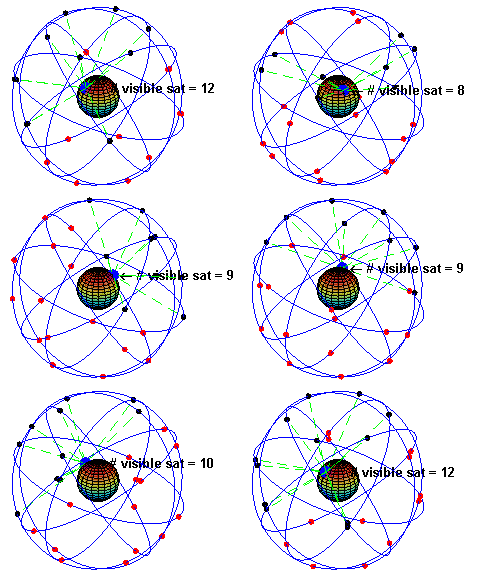
So let me start by removing the acronym.  GPS stands for Global Positioning Satellite.  But it really is not one satellite.  The term is used more broadly to describe all the 20 to 30 US based satellites used for navigational purposes, as well as most Earth based units that receive and use these satellite signals.

Nice image courtesy of Wikipedia
They work an an age old principle, often summarized as "triangulation".  Triangulation is by no means a new method.  It was used as far back as the 6th century BC by the Greek philosopher Thales to determine the height of pyramids.  It is also commonly used for surveying, navigation (land, sea an air), astronomy, and during warfare - to aim weapons accurately.
For basic triangulation, you need to have 2 known reference points (landmarks).  Wherever I am, as long as I have line of site, I can then get the compass direction to each of my reference points.  In geometry terms, I am just drawing an angled line from each of my reference points on a map, and find out where the 2 lines meet.  Presto!  I now know where I am as accurately as I measured the angles and know the exact locations of the reference points.  It also turns out that we can do almost the same calculation if we know the distance from the 2 reference points, without knowing the angles.
And that, in a nutshell, is what the GPS satellites help with.  Each GPS receiver has a circuit that can decode the radio waves from each satellite.  The satellites embeds distance markers in the radio signals they send, so my GPS receiver can extract the distance from my position to each of the satellites.  Also, satellites have known orbits, so even though they zip along at just under 9000 miles per hour, at any given time we know very precisely where they all are.  The only difference from the previous example, is that we now use more than 2 reference points, and we not only get our latitude and longitude, but also altitude.
Not so complicated after all - is it?

Next post - I will tell you why it really is that complicated!

Monday, January 3, 2011

A Geek's Christmas gift

If anyone of you was ever in doubt - please know I am a certified geek.  Really.
With that out of the way, let me show you a picture of the gift I got from my lovely wife Holly:
What - most of you are thinking - the heck - is that???

It is a GPS chip, and yes, she only knew to get it because I put it on my Amazon wish list.  If you have not tried that before - it is a great way to share gift ideas, especially if you are tough giftee as I am.

So it is a GPS chip.  The key circuit included in most of the Garmin and TomTom GPS car navigation systems.  I have to take a quick detour here and just say that I am constantly amazed at the progress technology has made over the last 20 years.  I used to work at TRW (now a part of Northrop), and did some pretty sophisticated work with GPS satellites and missile tracking.  What used to be a box the size of a desktop computer (or bigger), plus some pretty heavy duty processing power, now easily fits in a device that is about the size of a wristwatch and can be powered off a couple AA batteries.

So after futzing around with gizmo for a while, I now have it assembled and working with an Arduino microprocessor (shown below):


I am now able to decode all the GPS data coming off the chip, and using an Excel macro, read and process the information in real time.  As with any new toy, I like to understand all the gory details before I start to use it in some project...
For example... the precision of the unit *could* get me to knowing my position (latitude, longitude and height) to within about half a foot.  Unfortunately, its accuracy is only about 5-10 meters.  Good enough for most car navigation, but not so hot for my needs.  I am hoping to be able to reduce the errors a little with some judicious algorithms after analyzing the errors to which the device is susceptible.
But the greatest improvement I will likely achieve is using a system with 2 GPS devices - one stationary, the other able to move about the vicinity.  The stationary GPS will be at a known location.  It will broadcast the error between where it thinks it is, and where it actually is - to the mobile GPS - allowing it to correct for systematic errors.
I would like to use this unit for some kind of autonomous vehicle that could rove the yard - at some point it may even have some function - but for now it is just fun to get something to work for the sake of it.

I know my posts are once a blue moon, but maybe, just maybe, I can try to make that happen instead once every moon. 

Sunday, July 11, 2010

Rope-a-Dope

What do the following have in common?
  • Huns (Attila)
  • Greeks (Alexander the Great)
  • Moguls (Genghis Khan)
  • United Kingdom
  • Soviet Union
  • United States
This is an highly abbreviated list of the empires/countries that have tried, and failed, through military action, to subjugate the land we call Afghanistan.  As much as I would like to think that the "good ol' US of A" will end up differently, we would be ignorant to discount history.

The Afghans are a tough and resilient lot.  And much like a boxer matched against a stronger adversary, they let the strong wear themselves out - allowing the occupiers the delusion they are inflicting and weakening their enemy.  History shows that this is when occupation is at its most dangerous.

Zbigniew Brzezinski - who advised many US presidents, helped promulgate the US policy to arm the Afghan rebels against the occupying Soviets, an action whose purpose was to weaken and eventually topple the Soviet Union and the communist block.
The irony should not be lost on anyone that we are working on our 10th year of Afghan occupation, and that many of our economic woes can be directly tied to this and the Iraq wars.

In my opinion, our lame congressional leaders (and yes, president), need to get this country out of these occupations as the primary means of getting towards a balanced budget.  It is tiresome to see blowhards cut off unemployment, try to curtail benefits and help during arguably the worst economic situation since the great depression.  They parrot the same lines used by Hoover - and we all know how well he is remembered.

History grade for today's government:  F

Thursday, October 22, 2009

Photography....

Some of you may be aware that I aspire to be a good picture taker. I occasionally succeed with some stunning pictures, but I am sure a better eye and understanding of the nuances of all the myriad camera settings could only enhance the result (that, and having camera with at all times!).

Of course, some pictures can be helped with the suite of photoshop tools available. Who of us does not need to lighted/darken a picture, rotate or crop it? Recently I have discovered 2 things that I want to add to my repertoire of tools. HDR and image stitching.

HDR (High Dynamic Range) can be tricky, and really only works well with a tripod and static pictures. In essence, you take several pictures, at different exposures, and then combine the best of all the images. The results can subtly enhance your picture, or be quite dramatic. I have only begun my road towards working with this method, with some success.

Image stitching - if you ever want to have your pictures put to poster, you will find that even today's high mexapixel cameras won't get you there without some graininess. One solution is to take mutliple pictures, and use softare to stitch them together. Here is one stunning example of what can be achieved.


If any of you has had success with toolsets that help automate these processes, please, feel free to share. I am currently on the free kick, so am using GIMP for HDR work. Stitching is harder, and am working with a trial version of Panograph.

I will share more with you as I have successes and failures to report.

Saturday, October 17, 2009

Inter-Galactic Travel - part II

Last year I posted this very scientific sounding argument that intergalactic travel was pretty much impossible. The gist was that we best not even try, our puny speeds and the phenomenal distances preclude reaching any destination other than the void of space within one's lifetime.
Now, the interesting thing is that I was right, but for all the wrong reasons. That and nary a soul out there thought to challenge me.

So where did my reasoning fail? Turns out I was thinking like Newton, and not Einstein. By Newton, my math was impeccable. But Einstein, had he heard me spout my logic, would have turned in his grave. Via Lorentz contractions, which come from the universal speed of light, the universe in my direction of travel starts to compress like a pancake. That is to say, what used to be 10, 100 or more light years distant, is suddenly much closer. Ergo I get there faster.
But... and there is always a but - there is also this time dilation thing - so that time flows much slower for me - meaning that even if I have the technology, by the time I got back home, I would have missed more than dinner. I would have likely skipped a good number of generations. History would have listed me with a small footnote - "lost in space".
Actually - there is worse. Much worse. We all know space is not very friendly to life, what with a dearth of water and air. But turns out space is downright hostile to life - with cosmic rays and myriad other radations that would certainly cause a *little* problem. Sorta like living under an X-ray machine. Probably not the best for one's health, if you get my meaning. So you say, just add a little shielding... but did you know a meter of lead would not even be close to enough, especially if I am out travelling for years or decades? And if I need to shorten my trip, I go faster, but the faster I go, the more energetic (damaging)these pesky rays get. Catch 22.
So you see, I was right - we best get our jolly's from watching Sci-Fi. Just don't hold me to this, maybe one day someone will discover some fancy physics that will allow what today seems impossible.

Friday, October 9, 2009

You will laugh or you will cry...

Just returned from a lovely vacation - to our usual north shore retreat. On our last leg of the journey home we breakfasted at Amazing Grace. Picked up a local paper - the Duluth News Tribune. While I can't be certain, it is likely a fairly progressive read, much like the town that publishes this.

Holly spotted a comment on some prior editorial. I think I spit my coffee out laughing. In retrospect however, I think maybe I should have reacted with concern. Here, for your own "enjoyment", a picture of said comment.

Please note I redacted the name
of the commenter, to save him/her
the embarrassment. And while I have
no information on the "unbalanced"
editorial referenced, I certainly have
never hear of Bill O'Reilly as being calm.
I am fairly certain, in fact, that Bill would
be more than a little offended to have
anyone think that his rants are in any
way "calm".


It seems the divides that have always existed between conservative & liberal, democrat & republican, black & white, are deeper today than anytime in my short history. When congressmen yell "You lie!", when commentators refer to Bill as calm (can you tell I am ignoring the truthful part?), and pundits such a Bill and Rush want your and my U.S of A to fail in order to get to say "I told you so" - we are in need of someone who works to mend fences, both within and without our borders. It gives me great joy that Obama can join the ranks of such as Theodore Roosevelt, Albert Schweitzer and Mother Teresa as a leader recognized around the world as promoting peace and unity. About time.

Tuesday, October 21, 2008

Top 10 Scientific Advancements

The other day I was considering the breadth and depth of scientific knowledge that humans have amassed. While mind numbing, an easier task (maybe) would be to consider the advances in science that have been most transformational. Things that if we did not know, would have a dramatic impact on the way you and I live our daily lives.
Over the next couple of weeks I will share my list with you. And just to be arbitrary (blogger's prerogative), I am going to limit my list to 10 things.
In the meantime however, I would be very interested to hear from you.


So the open question is this -
What advancements in science do you think have most transformed the world we live in? You can be as specific or general as you want.

Thursday, October 9, 2008

The court of public opinion

There was a study conducted a short time ago. I heard it presented on NPR, and am sure it was published in some obscure science or psychology publication. I will leave that to the motivated reader to find ;-)

The study gathered relatively un-biased individuals. The group as a whole was surveyed for their “approval” of a certain candidate. The group was then presented with credible, damning information about this candidate. They were once again polled, and as expected, the approval declined precipitously. Now the interesting part. A second piece of information was presented that conclusively, and without ambiguity, showed that the first evidence was baseless and concocted. A final poll showed that the approval again improved, but did not return, not even close, to its original mark.

I am not quite sure what this says about people and their intelligence. I can say that it is obvious that emotions and feelings of mistrust come into play.
So what lesson can we take from this? Mud slinging works. And we know it works, because if it consistently failed, it would no longer be the political weapon of choice.

Which is why it is bothersome when I hear politicians neck deep in the mud. It is a very transparent effort to sway voters with falsehood. If you can’t win with the truth… well, truth is so limiting anyway. Plus, aren’t there two sides to every story? And we all love winners. Even if they had to cheat. It is the American way no?
But that is not the end of it. Some politicians not only want to cheat, but would prefer to not look bad while doing so. So they send underlings to go do the dirty work.

Someday, if we all evolve a little more, or are encouraged to use our God-given critical thinking skills, we will see these candidates for what they are. Cowardly liars.

Friday, October 3, 2008

Biden / Palin Debate Debacle

Ok, I guess I am getting in a rut on debate followup. Or maybe I am just being thorough in this critical election year. However, I did watch last nights' excuse for a debate.

Again, in salient pseudo-summary style, my takes on last night:
  • I probably gave this one away with my post title. With every ensuing political debate I watch, I am convinced that debating is now a lost art. Call me delusional, but the last time I checked, a debate includes: questions, relevant answers, and rebuttals, with a dash of moderation. Last night we got questions.
    Score: Biden 5; Plain 3; moderator 4
  • A good debate challenges participants to show their skill in critical thinking, accurate retrieval of facts, and yes, performance. One can score amazingly well with just the performance aspect provided for - perception is half the battle. Biden came across calm and collected. Palin nervous, shaky and over dramatic.
    On Performance - Score: Biden 6; Palin 3
  • Itemized lists are not my favorite means of communication (not for a debate anyhow). Biden loves them. Small but bothersome detail - getting lost in detailing an item in a list and forgetting the count or even that one IS counting.
  • Debaters often forget just how much they can sound like broken records. Yes, they are trying to engrave information in our heads, but that can only happen if we keep our attention on them long enough for the sponge action to happen. McCain/Palin just HAVE to find a better word than "maverick".
  • Non-sequiturs:
    --> Palin wants to address global warming, even though she either doesn't believe people are causing it, or doesn't think that its causes are important in trying to find a solution. Huh???
    --> Palin would like us to think that her faith based belief systems would not affect her ticket's stance on such issues as gay marriage/unions. Sadly both candidates are taking half measures on this civil-rights issue.
    --> Every politician wants to be the harbinger of change. As I understand the word "change", it is a relative term. You change FROM one thing TO another. And yet every time Biden tried to tar McCain with the Bush brush, Palin would chide him for looking only backwards. Not sure what her change is all about, other than a nice sounding word.
    Score: Biden 8; Palin 4
  • Spin on facts. Few things these days are true/false. Politicians know how to exploit this ambiguity to support their positions. There were several times last night where there was a disputed fact. Who voted for what and how often was brought up just a little too often, and seldom agreed on. Of course, that is a litmus test that means very little in these pork barrel days. Since few things voted on ever stand alone, one has to sully convictions by taking the bad with the good.
    Score: Tie.

Give a quick vote on the left hand side bar!