
If you are still with me - you only have to endure one more post on GPS related information.
OK... you really didn't have to breathe that sigh of relief now ;-)
Last time I wrapped up the basics on how GPS achieves the seemingly miraculous job of using a constellation of satellites to have you know where on Earth you are. But it seems I left you with a bit of a problem... the location you are getting reported is too inaccurate. OK, so you should know what city you are in, and maybe what side of the tracks you are on. But if you don't already know this, GPS accuracies are not likely the biggest of your problems!
So what is wrong? Several things: Leap seconds, Einstein and more Einstein.
What, you ask, the heck, is a leap second???? First off, let me get the disappointment done with early. What I know is limited... so you will just have to Wikipedia this for the gory details. Bottom line: just as every now and then calendars are adjusted with an extra day (leap years), so is our time occasionally in need of a minor tweak. Every so often, Earth standard time is nudged by a second. Keeps the time bean counters happy, or something like that. But unfortunately for the makers of GPS satellites, their atomic clocks are not adjustable. So each time we nudge time by a second, the GPS time and Earth time deviate by another second. We currently have something like 24 leap seconds since this practice was started. If we did not adjust for this, just accounting for Earth's rotation, we would be off by 6-7 miles or so.
So now we adjust for this, and we are quite a bit closer to the mark. But still off... so let's go visit Einstein.
Who doesn't know Einstein? I mean really. But many don't know much about what he brought to the physics world. Something about relativity, speed of light and energy.
We will ignore the ever famous E = mc squared. But the speed of light and relativity are very important to GPS. Radio signals travel at the constant speed of light. And that is how we generally know how long the Satellite signals should take to travel from the Satellite to where we are. I say generally - because I lied. Again. The speed of light is NOT constant. It is constant only in a true vacuum, as in space. But it tends to change speeds a little in an atmosphere, and also tends to bend a little as it goes though some of the atmosphere's layers. This is akin to when you are looking into a pool and things look a little distorted. Same thing happens to these Satellite signals. Again, more corrections need to be layered in if we really want to be accurate! Closer still... but there are 2 more effects that we need to address if we want accuracy that will help us navigate as drive the streets.
In Einstein's Special theory of Relativity, among its many implications, is that as you travel relative to another object at any significant speed, your clock slows down. Time just happens slower for you. And while our Satellites are zipping along pretty darn fast, the effect is minor. But still just big enough that we need to account for the change in the speed of the clock on the Satellite.
Later Einstein published his General Theory of Relativity. Very complicated - but again, I'll bottom line it for you. Gravity curves space-time. And our GPS satellites are experiencing slightly different gravity than you and I are here on the surface. So the space-time they are zipping past has a slightly different curvature than you and I do, and this too, translates into a clock that ticks a little faster than ours on the surface.
So when we account for Time dilation (Special theory of Relativity), Time contraction (General theory of Relativity), speed of light and its refraction through the atmosphere, and leap seconds - we now have a very accurate GPS position estimate.
And that little box sitting on your dash? The one you just take for granted. It does all of this - just so you don't get lost making the wrong turn somewhere!
Tuesday, January 25, 2011


Friday, January 21, 2011
GPS - Gets a *little* complicated...
Who doesn't love a good GPS unit? Makes for a hard time to get lost when driving in unfamiliar places. But, there is an awful lot of stuff going in in that teeny little box you take for granted.
Remember on my last post - how I said
Remember on my last post - how I said
"Not so complicated after all - is it?"
As I alluded, that is a bit of a white lie. Before I continue, an important caveat. This is not a technical blog. it is my aim to give a word explanation with near zero math. As such I will at times simplify a concept to a degree that technically speaking, it is incorrect. For those with knowledge about the subject, please indulge me a little!
OK - back to some explanations.
Yes, the concept of triangulating your position from satellite locations is in principle not hard to wrap your head around. All you need to know if the exact position of all the satellites, and the exact distance from each satellite to where you are. Satellite positions are the easy part. There are some pretty accurate ways to get their positions - in fact, part of the message these satellites embed in their radio signals is this very information.
The harder part is to determine just how far you are from any one satellite. Since we don't have a long enough yard stick, we instead measure the time it takes from a signal leaving the satellite to reach us. Then, knowing the speed of propagation of light, we get the corresponding distance.
That sounds good, but we are still left with some information we need. We need to knew just when that timing signal left the satellite, and we need to have a synchronized clock on hand for us to measure the interval. Sadly, we don't automatically have information about the time of departure for any of the satellite's timing radio signals. To make matters worse, we don't have accurate enough clocks on our tiny GPS receiver to accurately measure our distance. Each satellite has an atomic clock on board. You are not likely to have a spare one to use on hand!
It looks like we are at an impasse right? Wrong. Here comes a curve ball.
Remember the triangulation analogy - where if you want to know where you are, you need to have 2 landmarks and a distance to each one? A general rule, is that you can get one piece of information for each landmark you have. So one landmark... you only know one thing... the distance you measured. Not very helpful. Two landmarks, and you can determine your latitude and longitude. What happens if you have 3 landmarks? Turns out that if the 3 landmarks are well placed, you can find your height/altitude with respect to these landmarks. So going back to satellites....
If we know time where we are, we then need 3 Satellites to get our location (latitude, longitude, and height/altitude). But there is a trick we can use to help us out, when we don't know what time it is where we are. Turns out if you triangulate on 4 satellites, you get 4 pieces of information. With the right math, you can make the 4th item of information be your time! One problem down.
Now... for the Satellite time. If you recall, the Satellites broadcast their own position to assist us here on the ground to knew where they are. But - "where" implies a location, and that really does not mean anything without the proper time. And indeed, that is how we get Satellite timing - they send it to us!
With all this information on hand, we can now let a smart computer chip do the complicated math for us, and extract our time, height, latitude and longitude. All we need is 4 well placed GPS satellites.
This could be the end of the story, and is the end of this blog post. But wait...
The position we just calculated seems to be off the mark a little. Miles off!
How can ever we use this to navigate streets and such? What are we missing? Stay tuned :-)
Wednesday, January 12, 2011
GPS - A Primer
It has come to my attention that some people may not be too familiar with the details of GPS (refer to my last post).
So let me start by removing the acronym. GPS stands for Global Positioning Satellite. But it really is not one satellite. The term is used more broadly to describe all the 20 to 30 US based satellites used for navigational purposes, as well as most Earth based units that receive and use these satellite signals.
They work an an age old principle, often summarized as "triangulation". Triangulation is by no means a new method. It was used as far back as the 6th century BC by the Greek philosopher Thales to determine the height of pyramids. It is also commonly used for surveying, navigation (land, sea an air), astronomy, and during warfare - to aim weapons accurately.
For basic triangulation, you need to have 2 known reference points (landmarks). Wherever I am, as long as I have line of site, I can then get the compass direction to each of my reference points. In geometry terms, I am just drawing an angled line from each of my reference points on a map, and find out where the 2 lines meet. Presto! I now know where I am as accurately as I measured the angles and know the exact locations of the reference points. It also turns out that we can do almost the same calculation if we know the distance from the 2 reference points, without knowing the angles.
And that, in a nutshell, is what the GPS satellites help with. Each GPS receiver has a circuit that can decode the radio waves from each satellite. The satellites embeds distance markers in the radio signals they send, so my GPS receiver can extract the distance from my position to each of the satellites. Also, satellites have known orbits, so even though they zip along at just under 9000 miles per hour, at any given time we know very precisely where they all are. The only difference from the previous example, is that we now use more than 2 reference points, and we not only get our latitude and longitude, but also altitude.
Not so complicated after all - is it?
Next post - I will tell you why it really is that complicated!
So let me start by removing the acronym. GPS stands for Global Positioning Satellite. But it really is not one satellite. The term is used more broadly to describe all the 20 to 30 US based satellites used for navigational purposes, as well as most Earth based units that receive and use these satellite signals.
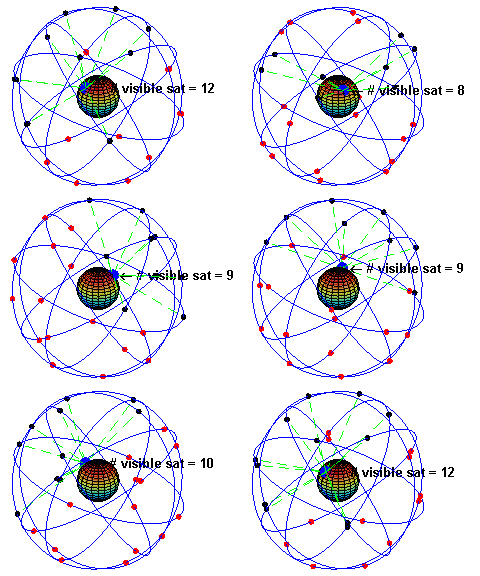 |
| Nice image courtesy of Wikipedia |
For basic triangulation, you need to have 2 known reference points (landmarks). Wherever I am, as long as I have line of site, I can then get the compass direction to each of my reference points. In geometry terms, I am just drawing an angled line from each of my reference points on a map, and find out where the 2 lines meet. Presto! I now know where I am as accurately as I measured the angles and know the exact locations of the reference points. It also turns out that we can do almost the same calculation if we know the distance from the 2 reference points, without knowing the angles.
And that, in a nutshell, is what the GPS satellites help with. Each GPS receiver has a circuit that can decode the radio waves from each satellite. The satellites embeds distance markers in the radio signals they send, so my GPS receiver can extract the distance from my position to each of the satellites. Also, satellites have known orbits, so even though they zip along at just under 9000 miles per hour, at any given time we know very precisely where they all are. The only difference from the previous example, is that we now use more than 2 reference points, and we not only get our latitude and longitude, but also altitude.
Not so complicated after all - is it?
Next post - I will tell you why it really is that complicated!
Monday, January 3, 2011
A Geek's Christmas gift
If anyone of you was ever in doubt - please know I am a certified geek. Really.
With that out of the way, let me show you a picture of the gift I got from my lovely wife Holly:


With that out of the way, let me show you a picture of the gift I got from my lovely wife Holly:

What - most of you are thinking - the heck - is that???
It is a GPS chip, and yes, she only knew to get it because I put it on my Amazon wish list. If you have not tried that before - it is a great way to share gift ideas, especially if you are tough giftee as I am.
So it is a GPS chip. The key circuit included in most of the Garmin and TomTom GPS car navigation systems. I have to take a quick detour here and just say that I am constantly amazed at the progress technology has made over the last 20 years. I used to work at TRW (now a part of Northrop), and did some pretty sophisticated work with GPS satellites and missile tracking. What used to be a box the size of a desktop computer (or bigger), plus some pretty heavy duty processing power, now easily fits in a device that is about the size of a wristwatch and can be powered off a couple AA batteries.
So after futzing around with gizmo for a while, I now have it assembled and working with an Arduino microprocessor (shown below):

I am now able to decode all the GPS data coming off the chip, and using an Excel macro, read and process the information in real time. As with any new toy, I like to understand all the gory details before I start to use it in some project...
For example... the precision of the unit *could* get me to knowing my position (latitude, longitude and height) to within about half a foot. Unfortunately, its accuracy is only about 5-10 meters. Good enough for most car navigation, but not so hot for my needs. I am hoping to be able to reduce the errors a little with some judicious algorithms after analyzing the errors to which the device is susceptible.
But the greatest improvement I will likely achieve is using a system with 2 GPS devices - one stationary, the other able to move about the vicinity. The stationary GPS will be at a known location. It will broadcast the error between where it thinks it is, and where it actually is - to the mobile GPS - allowing it to correct for systematic errors.
I would like to use this unit for some kind of autonomous vehicle that could rove the yard - at some point it may even have some function - but for now it is just fun to get something to work for the sake of it.
I know my posts are once a blue moon, but maybe, just maybe, I can try to make that happen instead once every moon.
I would like to use this unit for some kind of autonomous vehicle that could rove the yard - at some point it may even have some function - but for now it is just fun to get something to work for the sake of it.
I know my posts are once a blue moon, but maybe, just maybe, I can try to make that happen instead once every moon.
Sunday, July 11, 2010
Rope-a-Dope
What do the following have in common?
The Afghans are a tough and resilient lot. And much like a boxer matched against a stronger adversary, they let the strong wear themselves out - allowing the occupiers the delusion they are inflicting and weakening their enemy. History shows that this is when occupation is at its most dangerous.
Zbigniew Brzezinski - who advised many US presidents, helped promulgate the US policy to arm the Afghan rebels against the occupying Soviets, an action whose purpose was to weaken and eventually topple the Soviet Union and the communist block.
The irony should not be lost on anyone that we are working on our 10th year of Afghan occupation, and that many of our economic woes can be directly tied to this and the Iraq wars.
In my opinion, our lame congressional leaders (and yes, president), need to get this country out of these occupations as the primary means of getting towards a balanced budget. It is tiresome to see blowhards cut off unemployment, try to curtail benefits and help during arguably the worst economic situation since the great depression. They parrot the same lines used by Hoover - and we all know how well he is remembered.
History grade for today's government: F
- Huns (Attila)
- Greeks (Alexander the Great)
- Moguls (Genghis Khan)
- United Kingdom
- Soviet Union
- United States
The Afghans are a tough and resilient lot. And much like a boxer matched against a stronger adversary, they let the strong wear themselves out - allowing the occupiers the delusion they are inflicting and weakening their enemy. History shows that this is when occupation is at its most dangerous.
Zbigniew Brzezinski - who advised many US presidents, helped promulgate the US policy to arm the Afghan rebels against the occupying Soviets, an action whose purpose was to weaken and eventually topple the Soviet Union and the communist block.
The irony should not be lost on anyone that we are working on our 10th year of Afghan occupation, and that many of our economic woes can be directly tied to this and the Iraq wars.
In my opinion, our lame congressional leaders (and yes, president), need to get this country out of these occupations as the primary means of getting towards a balanced budget. It is tiresome to see blowhards cut off unemployment, try to curtail benefits and help during arguably the worst economic situation since the great depression. They parrot the same lines used by Hoover - and we all know how well he is remembered.
History grade for today's government: F
Thursday, October 22, 2009
Photography....
Some of you may be aware that I aspire to be a good picture taker. I occasionally succeed with some stunning pictures, but I am sure a better eye and understanding of the nuances of all the myriad camera settings could only enhance the result (that, and having camera with at all times!).
Of course, some pictures can be helped with the suite of photoshop tools available. Who of us does not need to lighted/darken a picture, rotate or crop it? Recently I have discovered 2 things that I want to add to my repertoire of tools. HDR and image stitching.
HDR (High Dynamic Range) can be tricky, and really only works well with a tripod and static pictures. In essence, you take several pictures, at different exposures, and then combine the best of all the images. The results can subtly enhance your picture, or be quite dramatic. I have only begun my road towards working with this method, with some success.
Image stitching - if you ever want to have your pictures put to poster, you will find that even today's high mexapixel cameras won't get you there without some graininess. One solution is to take mutliple pictures, and use softare to stitch them together. Here is one stunning example of what can be achieved.
If any of you has had success with toolsets that help automate these processes, please, feel free to share. I am currently on the free kick, so am using GIMP for HDR work. Stitching is harder, and am working with a trial version of Panograph.
I will share more with you as I have successes and failures to report.
Of course, some pictures can be helped with the suite of photoshop tools available. Who of us does not need to lighted/darken a picture, rotate or crop it? Recently I have discovered 2 things that I want to add to my repertoire of tools. HDR and image stitching.
HDR (High Dynamic Range) can be tricky, and really only works well with a tripod and static pictures. In essence, you take several pictures, at different exposures, and then combine the best of all the images. The results can subtly enhance your picture, or be quite dramatic. I have only begun my road towards working with this method, with some success.
Image stitching - if you ever want to have your pictures put to poster, you will find that even today's high mexapixel cameras won't get you there without some graininess. One solution is to take mutliple pictures, and use softare to stitch them together. Here is one stunning example of what can be achieved.
If any of you has had success with toolsets that help automate these processes, please, feel free to share. I am currently on the free kick, so am using GIMP for HDR work. Stitching is harder, and am working with a trial version of Panograph.
I will share more with you as I have successes and failures to report.
Saturday, October 17, 2009
Inter-Galactic Travel - part II
Last year I posted this very scientific sounding argument that intergalactic travel was pretty much impossible. The gist was that we best not even try, our puny speeds and the phenomenal distances preclude reaching any destination other than the void of space within one's lifetime.
Now, the interesting thing is that I was right, but for all the wrong reasons. That and nary a soul out there thought to challenge me.
So where did my reasoning fail? Turns out I was thinking like Newton, and not Einstein. By Newton, my math was impeccable. But Einstein, had he heard me spout my logic, would have turned in his grave. Via Lorentz contractions, which come from the universal speed of light, the universe in my direction of travel starts to compress like a pancake. That is to say, what used to be 10, 100 or more light years distant, is suddenly much closer. Ergo I get there faster.
But... and there is always a but - there is also this time dilation thing - so that time flows much slower for me - meaning that even if I have the technology, by the time I got back home, I would have missed more than dinner. I would have likely skipped a good number of generations. History would have listed me with a small footnote - "lost in space".
Actually - there is worse. Much worse. We all know space is not very friendly to life, what with a dearth of water and air. But turns out space is downright hostile to life - with cosmic rays and myriad other radations that would certainly cause a *little* problem. Sorta like living under an X-ray machine. Probably not the best for one's health, if you get my meaning. So you say, just add a little shielding... but did you know a meter of lead would not even be close to enough, especially if I am out travelling for years or decades? And if I need to shorten my trip, I go faster, but the faster I go, the more energetic (damaging)these pesky rays get. Catch 22.
So you see, I was right - we best get our jolly's from watching Sci-Fi. Just don't hold me to this, maybe one day someone will discover some fancy physics that will allow what today seems impossible.
Now, the interesting thing is that I was right, but for all the wrong reasons. That and nary a soul out there thought to challenge me.
So where did my reasoning fail? Turns out I was thinking like Newton, and not Einstein. By Newton, my math was impeccable. But Einstein, had he heard me spout my logic, would have turned in his grave. Via Lorentz contractions, which come from the universal speed of light, the universe in my direction of travel starts to compress like a pancake. That is to say, what used to be 10, 100 or more light years distant, is suddenly much closer. Ergo I get there faster.
But... and there is always a but - there is also this time dilation thing - so that time flows much slower for me - meaning that even if I have the technology, by the time I got back home, I would have missed more than dinner. I would have likely skipped a good number of generations. History would have listed me with a small footnote - "lost in space".
Actually - there is worse. Much worse. We all know space is not very friendly to life, what with a dearth of water and air. But turns out space is downright hostile to life - with cosmic rays and myriad other radations that would certainly cause a *little* problem. Sorta like living under an X-ray machine. Probably not the best for one's health, if you get my meaning. So you say, just add a little shielding... but did you know a meter of lead would not even be close to enough, especially if I am out travelling for years or decades? And if I need to shorten my trip, I go faster, but the faster I go, the more energetic (damaging)these pesky rays get. Catch 22.
So you see, I was right - we best get our jolly's from watching Sci-Fi. Just don't hold me to this, maybe one day someone will discover some fancy physics that will allow what today seems impossible.
Friday, October 9, 2009
You will laugh or you will cry...
Just returned from a lovely vacation - to our usual north shore retreat. On our last leg of the journey home we breakfasted at Amazing Grace. Picked up a local paper - the Duluth News Tribune. While I can't be certain, it is likely a fairly progressive read, much like the town that publishes this.
 Please note I redacted the name
It seems the divides that have always existed between conservative & liberal, democrat & republican, black & white, are deeper today than anytime in my short history. When congressmen yell "You lie!", when commentators refer to Bill as calm (can you tell I am ignoring the truthful part?), and pundits such a Bill and Rush want your and my U.S of A to fail in order to get to say "I told you so" - we are in need of someone who works to mend fences, both within and without our borders. It gives me great joy that Obama can join the ranks of such as Theodore Roosevelt, Albert Schweitzer and Mother Teresa as a leader recognized around the world as promoting peace and unity. About time.
Holly spotted a comment on some prior editorial. I think I spit my coffee out laughing. In retrospect however, I think maybe I should have reacted with concern. Here, for your own "enjoyment", a picture of said comment.
 Please note I redacted the name
 of the commenter, to save him/her
the embarrassment. And while I have
no information on the "unbalanced"
editorial referenced, I certainly have
never hear of Bill O'Reilly as being calm.
I am fairly certain, in fact, that Bill would
be more than a little offended to have
anyone think that his rants are in any
way "calm".
It seems the divides that have always existed between conservative & liberal, democrat & republican, black & white, are deeper today than anytime in my short history. When congressmen yell "You lie!", when commentators refer to Bill as calm (can you tell I am ignoring the truthful part?), and pundits such a Bill and Rush want your and my U.S of A to fail in order to get to say "I told you so" - we are in need of someone who works to mend fences, both within and without our borders. It gives me great joy that Obama can join the ranks of such as Theodore Roosevelt, Albert Schweitzer and Mother Teresa as a leader recognized around the world as promoting peace and unity. About time.
Tuesday, October 21, 2008
Top 10 Scientific Advancements
The other day I was considering the breadth and depth of scientific knowledge that humans have amassed. While mind numbing, an easier task (maybe) would be to consider the advances in science that have been most transformational. Things that if we did not know, would have a dramatic impact on the way you and I live our daily lives.
Over the next couple of weeks I will share my list with you. And just to be arbitrary (blogger's prerogative), I am going to limit my list to 10 things.
In the meantime however, I would be very interested to hear from you.
So the open question is this -
What advancements in science do you think have most transformed the world we live in? You can be as specific or general as you want.
Over the next couple of weeks I will share my list with you. And just to be arbitrary (blogger's prerogative), I am going to limit my list to 10 things.
In the meantime however, I would be very interested to hear from you.
So the open question is this -
What advancements in science do you think have most transformed the world we live in? You can be as specific or general as you want.
Thursday, October 9, 2008
The court of public opinion
There was a study conducted a short time ago. I heard it presented on NPR, and am sure it was published in some obscure science or psychology publication. I will leave that to the motivated reader to find ;-)
The study gathered relatively un-biased individuals. The group as a whole was surveyed for their “approval” of a certain candidate. The group was then presented with credible, damning information about this candidate. They were once again polled, and as expected, the approval declined precipitously. Now the interesting part. A second piece of information was presented that conclusively, and without ambiguity, showed that the first evidence was baseless and concocted. A final poll showed that the approval again improved, but did not return, not even close, to its original mark.
I am not quite sure what this says about people and their intelligence. I can say that it is obvious that emotions and feelings of mistrust come into play.
So what lesson can we take from this? Mud slinging works. And we know it works, because if it consistently failed, it would no longer be the political weapon of choice.
Which is why it is bothersome when I hear politicians neck deep in the mud. It is a very transparent effort to sway voters with falsehood. If you can’t win with the truth… well, truth is so limiting anyway. Plus, aren’t there two sides to every story? And we all love winners. Even if they had to cheat. It is the American way no?
But that is not the end of it. Some politicians not only want to cheat, but would prefer to not look bad while doing so. So they send underlings to go do the dirty work.
Someday, if we all evolve a little more, or are encouraged to use our God-given critical thinking skills, we will see these candidates for what they are. Cowardly liars.
The study gathered relatively un-biased individuals. The group as a whole was surveyed for their “approval” of a certain candidate. The group was then presented with credible, damning information about this candidate. They were once again polled, and as expected, the approval declined precipitously. Now the interesting part. A second piece of information was presented that conclusively, and without ambiguity, showed that the first evidence was baseless and concocted. A final poll showed that the approval again improved, but did not return, not even close, to its original mark.
I am not quite sure what this says about people and their intelligence. I can say that it is obvious that emotions and feelings of mistrust come into play.
So what lesson can we take from this? Mud slinging works. And we know it works, because if it consistently failed, it would no longer be the political weapon of choice.
Which is why it is bothersome when I hear politicians neck deep in the mud. It is a very transparent effort to sway voters with falsehood. If you can’t win with the truth… well, truth is so limiting anyway. Plus, aren’t there two sides to every story? And we all love winners. Even if they had to cheat. It is the American way no?
But that is not the end of it. Some politicians not only want to cheat, but would prefer to not look bad while doing so. So they send underlings to go do the dirty work.
Someday, if we all evolve a little more, or are encouraged to use our God-given critical thinking skills, we will see these candidates for what they are. Cowardly liars.
Friday, October 3, 2008
Biden / Palin Debate Debacle
Ok, I guess I am getting in a rut on debate followup. Or maybe I am just being thorough in this critical election year. However, I did watch last nights' excuse for a debate.
Again, in salient pseudo-summary style, my takes on last night:
Again, in salient pseudo-summary style, my takes on last night:
- I probably gave this one away with my post title. With every ensuing political debate I watch, I am convinced that debating is now a lost art. Call me delusional, but the last time I checked, a debate includes: questions, relevant answers, and rebuttals, with a dash of moderation. Last night we got questions.
Score: Biden 5; Plain 3; moderator 4 - A good debate challenges participants to show their skill in critical thinking, accurate retrieval of facts, and yes, performance. One can score amazingly well with just the performance aspect provided for - perception is half the battle. Biden came across calm and collected. Palin nervous, shaky and over dramatic.
On Performance - Score: Biden 6; Palin 3 - Itemized lists are not my favorite means of communication (not for a debate anyhow). Biden loves them. Small but bothersome detail - getting lost in detailing an item in a list and forgetting the count or even that one IS counting.
- Debaters often forget just how much they can sound like broken records. Yes, they are trying to engrave information in our heads, but that can only happen if we keep our attention on them long enough for the sponge action to happen. McCain/Palin just HAVE to find a better word than "maverick".
- Non-sequiturs:
--> Palin wants to address global warming, even though she either doesn't believe people are causing it, or doesn't think that its causes are important in trying to find a solution. Huh???
--> Palin would like us to think that her faith based belief systems would not affect her ticket's stance on such issues as gay marriage/unions. Sadly both candidates are taking half measures on this civil-rights issue.
--> Every politician wants to be the harbinger of change. As I understand the word "change", it is a relative term. You change FROM one thing TO another. And yet every time Biden tried to tar McCain with the Bush brush, Palin would chide him for looking only backwards. Not sure what her change is all about, other than a nice sounding word.
Score: Biden 8; Palin 4 - Spin on facts. Few things these days are true/false. Politicians know how to exploit this ambiguity to support their positions. There were several times last night where there was a disputed fact. Who voted for what and how often was brought up just a little too often, and seldom agreed on. Of course, that is a litmus test that means very little in these pork barrel days. Since few things voted on ever stand alone, one has to sully convictions by taking the bad with the good.
Score: Tie.
Give a quick vote on the left hand side bar!
Saturday, September 27, 2008
Obama / McCain Debate
For anyone who asks - my political leanings and preferences are not a secret.
So let me start by saying that I consider myself an independent, and could vote republican, democrat, or any other party if I felt the candidate would do his/her job successfully.
This year, barring any large surprises, I will vote for Obama.
So now that my political leanings and biases are well established - here is my take on last night's debate.
So let me start by saying that I consider myself an independent, and could vote republican, democrat, or any other party if I felt the candidate would do his/her job successfully.
This year, barring any large surprises, I will vote for Obama.
So now that my political leanings and biases are well established - here is my take on last night's debate.
- Even if McCain does not respect Obama's politics or opinions, he should respect HIM. He was disrespectful and condescending last night. Not a trait I want to see any more of in this county's executive branch.
- Obama may be a little hurt by being overly respectful. To concede that your opponent is occasionally right (i.e. you agree with him), works well in most arenas (barring politics). He might have instead used the words "I am glad, Senator McCain, that you agree with my position on...
. Same thing, but assumes ownership of the idea. - Did anyone notice McCain's odd mannerisms every time Obama spoke? It was painful to watch. I know McCain was trying to use Obama's air-time to silently communicate disagreement, amusement and condescension. If that was an overt strategy on his part, in my opinion it is something he should immediately discontinue.
- Obama still panders a little too much for my liking. Example - McCain touted that he wears a POW bracelet. Mind you, I really couldn't care less. Instead of letting it pass uncommented, Obama said he too wore one. Now I *think* he was trying to say "so what if you wear one, how exactly does that qualify you to be president?". In these ridiculously political days - he could not say that without offending some veterans, or being misquoted. He should have let McCain's comment slide.
- McCain's intent was a little to single-minded and obvious. He wants to mention that he is the candidate with experience. Barrak is too young, too inexperienced, and naive. However, the punch was missing. For me to make that point, I need to expound on HOW my opponent is displaying that naivete. He failed to do that. In fact, there were several occasions when Obama spoke about a topic; McCain followed up with his too oft spoken "You just don't understand", and then proceeded to repeat the same basic points Obama said. Sorta takes the punch out of the take home when you speak from both sides of your mouth.
Monday, September 1, 2008
How business is done
As a general rule, business exists where profit can be made. Pretty basic stuff. Nothing wrong with making a profit. Of course, to make a profit, I usually have to sell something. Usually goods or services. When the supply greatly exceeds demand, prices tend to asymptotically approach the "zero profit" line. This is not really good for business, and tends to dispose of the more inefficient companies, and discourage new entrants into this market. In the end, a fairly good
balance can take place with proper free market driving forces. Everyone benefits, both consumer and business.
But how does this translate to the oil industry?
For starters, you are not very likely today to see many new entries into this market. It takes too much money to get started, and small businesses just don't have the economies of scale necessary to be competitive. So very limited competition.
On the demand end - how much choice does the average person have to reduce gas consumption? There is a little wiggle room, but not much. So we have a fairly fixed demand on a per capita basis, at least here in the USA. (Side note - if we were talking the lobster business, and prices tripled, people would stop eating lobster. Problem solved. But since the world's industry is based largely on oil - price increases will become inflationary).
Everyone knows that oil reserve supplies are limited, yet I am not of the opinion that this is THE reason for the price hikes we have seen over the last 2-3 years. The key suppliers of crude have made sure to allocate production to "match" demand. In the oil industry, excess is difficult to maintain, as you can only store so much oil. So one might infer that this is just how this business needs to be run. But wait. Haven't global markets recently stretched supplies? Driven prices upward? Indeed. And there were few industry experts who were surprised. We have had no fewer than 5-10 years "notice". So why wasn't the industry prepared?
Because that would be bad business. A couple minor shortfalls in supply do wonders for prices. And everybody in the business celebrates. Crude oil suppliers, refiners, and oil/gas distributers. Executives get well deserved pats on that back and record shattering bonuses, stock options, retirement benefits, etc. Again, nothing new about this.
Just don't expect drilling to add much to global market supplies. And don't be so naive to think that if we drill in the USA, or off-shore, that we somehow have dibs on this supply. Unless this country abandons the free market realm and nationalizes the oil industry - oil drilled here will be sold on the world market. Of course, even this is short-sighted. What incentive do oil companies have in off-shore drilling? They have a winning combination right this moment, and they have no desire to invest many billions of dollars in additional off-shore drilling that will only serve to reduce their profit margin. There are allocated lands on-shore today they have not drilled. There may be many reasons, the largest is lack of incentive.
So why do you suppose there is such a "drill, and drill now" mantra being spoken by both sides of the aisle? Because the sheeple want to think that their government is looking out for them, and government is all too willing to strike any pose to garner their votes. End of story.
The prevailing belief is that we have an oil shortage. It is a myth. Oil production has never been higher. The world demand has just outstripped this and other nations' abilities to REFINE the oil. So drill all we want, if the refining capacity is not increased, then we have no more gas.
Will there be ANY winners in the "drill now" crowd? Minimal. Add a couple percentage points (at most) to global oil supplies starting in 10 years or so. Employ a few thousand people. Make people *feel* better, even if they pay the same price at the pump.
Who loses? The environment. Our trust that the government can address a problem with a real solution. Politician's honesty.
The longer we keep looking in the wrong places, with simple-minded solutions to complex problems, the harder the fall will be when we get caught with our pants further down than they already are. Government and big business make for a nefarious combination when allied against the people. And although we the people hold the trump card, we refuse to play it. When we do, we can only hope it won't be too late.
Saturday, September 8, 2007
Harbinger
Finally have been able to sit for a short bit and write out a little more of my story.
For those who may need a short refresher, you will be able to find all the entries for this story under the Label "Crossing" on the left side column. The post headings are more closely related to chapters, even if short ones! Enjoy!
(conclusion of "Inaugural")
Brandon walked to the aft porthole, his attention drawn to the string of tropical storms and hurricanes so typical for this time of year. Today they could not match his dark mood, or the storms he knew were headed this way, 400 miles up. He could only hope they did not make landfall on his shores.
Even the visor’s thick shielding would not protect Margo’s eyes from the sun’s scorching brightness, so she closed her eyes and focused on the trio of unmelodious notes coming from her range-finder. Most people floating over 22,000 miles above Terra firma, with less than 3 hours of breathable air, and blinded by the sun would have panicked long ago. But then, she was not most people. In fact she disliked people, and would have chosen this isolated patch of space over anyone’s company. She had even been audacious enough to reject promotions for her exceptional abilities, fearing the confinement of a desk and the company of incompetents.
The scheduled third quarter inspection was still two weeks away, but the date had been moved up to satisfy some government bureaucrat. She thought them all fools, but was glad to be here nonetheless. This was her third inspection at the heart of Pinnacle’s tether; the only spot where you could truly experience zero G. Pulled by gravity at one end, centrifugal forces at the other, this magic spot was where the high tech tether “hung” in both directions. It seemed a rope at this spot suffered the same lack of a sense of up and down as people did. It also happened to be where the highest tension was exerted. All things being equal, this was where a failure would be most likely to occur. Physical inspections were the most laborious but fruitful means of ensuring the safety of Pinnacle.
The scheduled third quarter inspection was still two weeks away, but the date had been moved up to satisfy some government bureaucrat. She thought them all fools, but was glad to be here nonetheless. This was her third inspection at the heart of Pinnacle’s tether; the only spot where you could truly experience zero G. Pulled by gravity at one end, centrifugal forces at the other, this magic spot was where the high tech tether “hung” in both directions. It seemed a rope at this spot suffered the same lack of a sense of up and down as people did. It also happened to be where the highest tension was exerted. All things being equal, this was where a failure would be most likely to occur. Physical inspections were the most laborious but fruitful means of ensuring the safety of Pinnacle.
With half her oxygen depleted, she heard the tell-tale beat frequency which indicated she was 1 meter from the tether. A quick jet blast and she hovered motionless alongside the East Tether, in the sun’s shadow again. She opened her eyes, and as her pupils adjusted to the contrasting darkness, was puzzled by what looked like reflected sunlight along the tether. It resembled the pattern one often saw at the bottom of a swimming pool. Even though this was not any of the problems she was trained to detect, and it might be nothing more than a reflection from a nearby satellite or some other space anomaly, she would need to record and report this. She removed the holographic recorder and comm’ed in that she would take longer to rendezvous with the rest of the team. She smiled, secretly pleased there was a reason to prolong her solitude.
Saturday, September 1, 2007
Inaugural (story continued)
Little bits at a time, I add to my story. We leave our fancy elevator momentarily...
 “What’s wrong?” asked Brandon, noticing the freshly furrowed brow on Evan’s face. Evan was manning the Hyper Spectral imaging computers, which were currently running diagnostics and calibrations on the soon to be unveiled Pinnacle Observatory.
“It looks like there might be a problem with the calibration algorithms. The diagnostics are coming back normal, but there are a number of stellar grids that are failing to calibrate.”
Now it was Brandon’s turn to be concerned. “I thought we exercised all this two, four and six weeks ago? Why didn’t we see a problem then?”
There was no answer to give, so Evan remained silent, intently studying the cryptic numbers littering the computer consoles. He knew what was at stake. They were six hours away from THE official ribbon cutting ceremony, when the new Observatory would officially become operational. Scientists, and not just those in the particle physics and cosmology fields, had been anticipating this day for years. It heralded the arrival of the most advanced tool in the arsenal of cosmic observatories. Hubble had radically revolutionized and advanced science – there was no less hope for Pinnacle One. It was not just another telescope. It was the culmination of decades of research into the emerging quantum sensor field, a specialization of the very successful quantum computer revolution.
The only fear was that this tool was as good as science could ever hope for. A single photon could be sensed accurately. Sophisticated computers would process the information in near real time and correlate amplitudes, frequencies, phases. The claim was that this observatory would be able to perform coherent observation throughout the entire observable spectrum. There were still many skeptics, who simply would not believe any system could be built to the exacting tolerances and specifications to make the theoretical system work.
The station had been preparing for months for the arrival of scientific, political and financial VIPs. Security had never been tighter. And the only day they were not allowed to have a problem? Today.
Evan’s momentary lapse into contemplations of a premature end to his budding career were interrupted “You know, if you are messing with my mind here…”.
“Nope, wish I was”.
“So what next genius? How long should I give you to figure out if this is a glitch or a real problem?”
“One second…” Evan was not the most stellar multi-tasker. However he was one of the best in his field. Brandon watched with a mix of confusion and admiration while Evan tapped away, with screens opening and closing almost too fast to take in the content. As fast as he worked, precious minutes were ticking away, each one heightening Brandon’s impatience. Finally Even slowed down, and looked over, saying “Here goes nothing”. He opened the switch guard, and pressed the glowing Calibrate button. The screen began filling in a complex checkerboard with numbers. One by one they began turning green, the universal color signifying all is well. But then the same grids as before flashed red. Both men muttered under their breath. “You better start panicking and call in the reinforcements boss”, said Evan. “We might be able to reboot the computer, but there is no guarantee that is the problem. And the reboot sequence takes about an hour to complete to get back to this point. If this is an issue with the programming, or worse, the hardware, we might not even have time to diagnose the root problem, much less fix it.
Inaugural
 “What’s wrong?” asked Brandon, noticing the freshly furrowed brow on Evan’s face. Evan was manning the Hyper Spectral imaging computers, which were currently running diagnostics and calibrations on the soon to be unveiled Pinnacle Observatory.
“It looks like there might be a problem with the calibration algorithms. The diagnostics are coming back normal, but there are a number of stellar grids that are failing to calibrate.”
Now it was Brandon’s turn to be concerned. “I thought we exercised all this two, four and six weeks ago? Why didn’t we see a problem then?”
There was no answer to give, so Evan remained silent, intently studying the cryptic numbers littering the computer consoles. He knew what was at stake. They were six hours away from THE official ribbon cutting ceremony, when the new Observatory would officially become operational. Scientists, and not just those in the particle physics and cosmology fields, had been anticipating this day for years. It heralded the arrival of the most advanced tool in the arsenal of cosmic observatories. Hubble had radically revolutionized and advanced science – there was no less hope for Pinnacle One. It was not just another telescope. It was the culmination of decades of research into the emerging quantum sensor field, a specialization of the very successful quantum computer revolution.
The only fear was that this tool was as good as science could ever hope for. A single photon could be sensed accurately. Sophisticated computers would process the information in near real time and correlate amplitudes, frequencies, phases. The claim was that this observatory would be able to perform coherent observation throughout the entire observable spectrum. There were still many skeptics, who simply would not believe any system could be built to the exacting tolerances and specifications to make the theoretical system work.
The station had been preparing for months for the arrival of scientific, political and financial VIPs. Security had never been tighter. And the only day they were not allowed to have a problem? Today.
Evan’s momentary lapse into contemplations of a premature end to his budding career were interrupted “You know, if you are messing with my mind here…”.
“Nope, wish I was”.
“So what next genius? How long should I give you to figure out if this is a glitch or a real problem?”
“One second…” Evan was not the most stellar multi-tasker. However he was one of the best in his field. Brandon watched with a mix of confusion and admiration while Evan tapped away, with screens opening and closing almost too fast to take in the content. As fast as he worked, precious minutes were ticking away, each one heightening Brandon’s impatience. Finally Even slowed down, and looked over, saying “Here goes nothing”. He opened the switch guard, and pressed the glowing Calibrate button. The screen began filling in a complex checkerboard with numbers. One by one they began turning green, the universal color signifying all is well. But then the same grids as before flashed red. Both men muttered under their breath. “You better start panicking and call in the reinforcements boss”, said Evan. “We might be able to reboot the computer, but there is no guarantee that is the problem. And the reboot sequence takes about an hour to complete to get back to this point. If this is an issue with the programming, or worse, the hardware, we might not even have time to diagnose the root problem, much less fix it.
Tuesday, August 28, 2007
Intergalactic travel – science or fiction?
I doubt any of you have failed to read a book or watch a movie that has dabbled with the fictional account of travel to other worlds. Specifically, somewhere within our galaxy; perchance a planet somewhat like ours, orbiting some distant star. But what if you wanted to know if there was even the remotest sliver of possibility in these accounts? I have recently tried to convince myself of the possibility, only to find that the hurdles required to accomplish such a feat in anything but fictional accounts are astronomical indeed.
Just to put this in perspective. Lets take the nearest star outside of our sun as our galactic destination. That would be Alpha Centauri. A favorite of sci-fi authors precisely because of its nearness. How near is it? Well, if you had a nicely paved road, and obeyed typical freeway speed limits, it would take you just under a billion years to get there. Ok, we know we all speed a little. Half a billion. I still think you will need to stop here and there to stretch your legs along the road. Silly me – who drives a car to a star? Let’s instead take a fancy space shuttle. At nearly 18,000 mph, we can reduce our travel time to about a million years! I think we might get hungry along the way. Too bad there are no small towns or gas stations where we could stop and refill.
So if we are not going to take the shuttle, what could we take? We could try other options, like light sails, ionic or nuclear propulsion systems. But, we will instead cut to the chase. Let’s assume you have the most advanced propulsion system that can theoretically exist. An antimatter drive! Yup, antimatter is real. Not much of it yet, but it can be made, even if it is but one atom at a time. Let’s further assume you want to get there and return to tell of your tale to someone you know. Forty years sounds about right. Twenty years out, twenty back. That, in case you were doing the math, is 1/5th of the speed of light. On average! How much antimatter would it take to do this? Depends greatly on how big a ship you intend on taking for a spin. But roughly speaking, maybe a ton of antimatter would do it. So if someone handed me a ton of antimatter, could it be done? Not today. Remember, I still have to control the antimatter-matter annihilations that create my propulsive energy. And trust me, to get me there and back in the required time, we have to burn it hot. Real hot. Too hot for any known element to withstand. And then there is the unpleasantness of radiation, and the Kuiper belt, and the Oort cloud to get past; and all this just within our own puny solar system. Not to mention having to eat, drink, breathe and keep warm for all those years.
I guess what I am saying is that you should not hold your breath for any imminent human travels beyond our backyard. A shame. I so enjoyed holding on to the illusion of possibility!
Just to put this in perspective. Lets take the nearest star outside of our sun as our galactic destination. That would be Alpha Centauri. A favorite of sci-fi authors precisely because of its nearness. How near is it? Well, if you had a nicely paved road, and obeyed typical freeway speed limits, it would take you just under a billion years to get there. Ok, we know we all speed a little. Half a billion. I still think you will need to stop here and there to stretch your legs along the road. Silly me – who drives a car to a star? Let’s instead take a fancy space shuttle. At nearly 18,000 mph, we can reduce our travel time to about a million years! I think we might get hungry along the way. Too bad there are no small towns or gas stations where we could stop and refill.
So if we are not going to take the shuttle, what could we take? We could try other options, like light sails, ionic or nuclear propulsion systems. But, we will instead cut to the chase. Let’s assume you have the most advanced propulsion system that can theoretically exist. An antimatter drive! Yup, antimatter is real. Not much of it yet, but it can be made, even if it is but one atom at a time. Let’s further assume you want to get there and return to tell of your tale to someone you know. Forty years sounds about right. Twenty years out, twenty back. That, in case you were doing the math, is 1/5th of the speed of light. On average! How much antimatter would it take to do this? Depends greatly on how big a ship you intend on taking for a spin. But roughly speaking, maybe a ton of antimatter would do it. So if someone handed me a ton of antimatter, could it be done? Not today. Remember, I still have to control the antimatter-matter annihilations that create my propulsive energy. And trust me, to get me there and back in the required time, we have to burn it hot. Real hot. Too hot for any known element to withstand. And then there is the unpleasantness of radiation, and the Kuiper belt, and the Oort cloud to get past; and all this just within our own puny solar system. Not to mention having to eat, drink, breathe and keep warm for all those years.
I guess what I am saying is that you should not hold your breath for any imminent human travels beyond our backyard. A shame. I so enjoyed holding on to the illusion of possibility!
Sunday, August 19, 2007
Ascent (continued)
We interrupt the regularly scheduled post to bring you the next installment of my fictional account! (click here if you need to find the first installment!)
 The opportunity to work in the most technologically advanced facility on the planet warranted taking some risks.
 The opportunity to work in the most technologically advanced facility on the planet warranted taking some risks.
 “Thirty seconds to magnetic braking” chimed the voice, and was surprised that he had not paid the least attention to the multitude of other altitude reminders – information that reduced this miracle to an accounting of distance. He braced himself for the expected rough stop, only to find that when the brakes engaged, they felt fluid and natural. He wished his New York apartment elevators were as smooth. When the last settling motions finally came to a stop, he almost laughed at the ding – so reminiscent was it of any other elevator.
But there was where the similarity stopped. It had taken over a decade to manufacture the 260,000 tons of carbon composite nano-tubes that comprised the cables which hoisted people and goods up and down the space elevator’s length. Not to mention the decades of research required to overcome the issues, known and unknown. Radiation, lightning strikes, jet stream, meteorites, safety, cost, and ownership were but the most often cited issues that had kept this modern wonder from being built. There had been skeptics even after it was built, and probably still were. Though 11 years without a major mishap had quelled most of their predictions of doom.
Alan knew that the name “Pinnacle One” was intended to connote height, but still thought it more appropriately denoted one of man’s ultimate achievements. Almost as impressive as the technological prowess required to pull off its construction and maintenance, was the political cooperation that had been required. Building Pinnacle would have bankrupted a dozen average countries. Combined. People of some prominence had also pointed out the Panama Canal tragedy of ’44 as a warning and lesson. So when it came time to establish the necessary multi-national funding, all contributors were welcomed, the prevalent wisdom being that the likelihood of sabotage by a disgruntled nation was inversely proportional to its investment and return. It had taken years of patient negotiation to achieve the necessary buy-in. Even so there has been a couple of holdouts. Nations and peoples that had been effectively waging undeclared wars for hundreds if not thousands of years would never be sufficiently reconciled to sign an agreement, much less sit at the same table. Provisional use agreements were set up in order to keep even these dissenters as involved as they could be. Even with all this, Alan still held on to some deep misgivings. Would some misguided zealot think himself the agent of a God intent of sundering this edifice - as was the tower of Babel over 5000 years ago? He had not occupied himself with these concerns much before, but couldn't stop the panicky thoughts each time he heard, or worse, felt, the unfamiliar creaks and groans from the elevator.
His unpleasant thoughts were interrupted as he heard the hiss of air and his ears pop with the equalization of pressure needed before the doors would open and admit him to Pinnacle City. As the door opened unceremoniously, his fears melted away, a sense of awe overpowering him.
But there was where the similarity stopped. It had taken over a decade to manufacture the 260,000 tons of carbon composite nano-tubes that comprised the cables which hoisted people and goods up and down the space elevator’s length. Not to mention the decades of research required to overcome the issues, known and unknown. Radiation, lightning strikes, jet stream, meteorites, safety, cost, and ownership were but the most often cited issues that had kept this modern wonder from being built. There had been skeptics even after it was built, and probably still were. Though 11 years without a major mishap had quelled most of their predictions of doom.
Alan knew that the name “Pinnacle One” was intended to connote height, but still thought it more appropriately denoted one of man’s ultimate achievements. Almost as impressive as the technological prowess required to pull off its construction and maintenance, was the political cooperation that had been required. Building Pinnacle would have bankrupted a dozen average countries. Combined. People of some prominence had also pointed out the Panama Canal tragedy of ’44 as a warning and lesson. So when it came time to establish the necessary multi-national funding, all contributors were welcomed, the prevalent wisdom being that the likelihood of sabotage by a disgruntled nation was inversely proportional to its investment and return. It had taken years of patient negotiation to achieve the necessary buy-in. Even so there has been a couple of holdouts. Nations and peoples that had been effectively waging undeclared wars for hundreds if not thousands of years would never be sufficiently reconciled to sign an agreement, much less sit at the same table. Provisional use agreements were set up in order to keep even these dissenters as involved as they could be. Even with all this, Alan still held on to some deep misgivings. Would some misguided zealot think himself the agent of a God intent of sundering this edifice - as was the tower of Babel over 5000 years ago? He had not occupied himself with these concerns much before, but couldn't stop the panicky thoughts each time he heard, or worse, felt, the unfamiliar creaks and groans from the elevator.
His unpleasant thoughts were interrupted as he heard the hiss of air and his ears pop with the equalization of pressure needed before the doors would open and admit him to Pinnacle City. As the door opened unceremoniously, his fears melted away, a sense of awe overpowering him.
Sunday, August 12, 2007
Global Warming, Evolution and The fate of the Universe...
Ok - so I just used a title that may have more buzz and controversy associated with it than any other I am likely to use again.
The genesis for this post came from the latest article I read about Global Warming. Or rather, the 260 comments left on the ABC news article. I didn't read them all. After a while they all tended to one of a number of equivalent slants. From "Global Warming is the greatest hoax to be perpetrated" to "We are all about to die". There is much fertile middle ground where the real answer is most likely to exist.
However I digress. One of the assumptions (or at least simplifications) used by many for this and many other arguments, is that this planet is a closed system. In physics, a closed system must obey certain laws. Conservation of energy (1st law of thermodynamics) and the increase in entropy or randomness (2nd law of thermodynamics) to name a couple.
But we can be thankful that this is not the case.
The genesis for this post came from the latest article I read about Global Warming. Or rather, the 260 comments left on the ABC news article. I didn't read them all. After a while they all tended to one of a number of equivalent slants. From "Global Warming is the greatest hoax to be perpetrated" to "We are all about to die". There is much fertile middle ground where the real answer is most likely to exist.
However I digress. One of the assumptions (or at least simplifications) used by many for this and many other arguments, is that this planet is a closed system. In physics, a closed system must obey certain laws. Conservation of energy (1st law of thermodynamics) and the increase in entropy or randomness (2nd law of thermodynamics) to name a couple.
But we can be thankful that this is not the case.
Sunshine abounds, energizing and allowing life to thrive on this planet. Without sunshine, the Earth's albeto would have left our plant cold and lifeless long ago.
Solar and galactic radiation bombard our planet every moment - providing some of the necessary elements for weather and change. We may slather ourselves with sunscreens and lotions to avoid the abuse of solar radiation - but without it, aeons ago our ancestral lines might have never progressed to leave the oceans.
While there are few things that can compete with the fate of the human race, some physicists have pondered the question on a more cosmic scale. They believe that the universe is cooling down (doesn't that sound like a good balancer to global warming?). That is one more way of saying entropy is increasing, and the available "useful" energy that can do work and support life is diminishing. Ok, the process is purportedly going to take billions of years to happen. You and I, and likely humanity as a whole will never have to address this impending universal Armageddon. So why bring this up? Because humanity consistently sizes their universe to the size of their imagination. You can guess which one wins. I have read enough physics (and fiction I admit) to be of the opinion that even our universe is unlikely to fall in the "closed system" category. I can't imagine what lies outside this universe. It could be that we live in what some have called a "foam" of universes. Or there may be nearly infinite universes, each existing as a finite probability. No matter what though, scientists can only base their hypothesis and theories on what is observable today. But if any of these assumptions are wrong... then some of the more basic tenets of science could be but approximations to a greater truth. And if there are more universes that can interact with this one - then maybe the end science foresees for this universe will not come to pass.
Solar and galactic radiation bombard our planet every moment - providing some of the necessary elements for weather and change. We may slather ourselves with sunscreens and lotions to avoid the abuse of solar radiation - but without it, aeons ago our ancestral lines might have never progressed to leave the oceans.
While there are few things that can compete with the fate of the human race, some physicists have pondered the question on a more cosmic scale. They believe that the universe is cooling down (doesn't that sound like a good balancer to global warming?). That is one more way of saying entropy is increasing, and the available "useful" energy that can do work and support life is diminishing. Ok, the process is purportedly going to take billions of years to happen. You and I, and likely humanity as a whole will never have to address this impending universal Armageddon. So why bring this up? Because humanity consistently sizes their universe to the size of their imagination. You can guess which one wins. I have read enough physics (and fiction I admit) to be of the opinion that even our universe is unlikely to fall in the "closed system" category. I can't imagine what lies outside this universe. It could be that we live in what some have called a "foam" of universes. Or there may be nearly infinite universes, each existing as a finite probability. No matter what though, scientists can only base their hypothesis and theories on what is observable today. But if any of these assumptions are wrong... then some of the more basic tenets of science could be but approximations to a greater truth. And if there are more universes that can interact with this one - then maybe the end science foresees for this universe will not come to pass.
We can only hope that our small world will be saved from Global Warming by similar short sighted mistakes and assumptions the majority of scientists and climatologists espouse!
Wednesday, August 8, 2007
Speed of Light - Revisited
Ok, so you think I am just going to write fiction on this blog?
Interestingly, the following might sound more like fiction than what really is. You tell me...
Everyone knows, or at least I hope, that the speed of light in a vacuum is constant. We give its speed a special name: "c". Yes, the same c from Einstein's famous equation, E=mc^2.
Interestingly, the following might sound more like fiction than what really is. You tell me...
Everyone knows, or at least I hope, that the speed of light in a vacuum is constant. We give its speed a special name: "c". Yes, the same c from Einstein's famous equation, E=mc^2.
Side note: For those like myself who have impaired html abilities, the "^" denotes squared.
To remove any math, let me draw a simple analogy. Imagine a compass, with just the North South line, and perpendicular East West line. Traveling North represents you moving through time. West is you moving through space. Normally, we think that moving through time (North) is a constant. Watches tick regularly, etc. But when you move through space (West) relative to an observer, it turns out that you actually slow down your progress through time. The effect is small for any speed you and I can easily achieve, but if you could travel the actual speed of light, time would literally stop! Per the analogy - you have changed your compass heading.
But here is the tricky part - you have NOT modified your overall speed. The combined speed in space-time is still the speed of light! Just like the compass needle, your speed did not get longer or shorter, it just turned a little off the its original Northerly heading.
So far, if you don't start asking some questions, this just seems like one more useless thought experiment. So...
If we are fairly stationary in space, are we saying that we are still moving at the speed of light? The curious answer is YES. We move though the time dimension at the speed of light! When we get into the Starship enterprise and start moving at sci-fi speeds approaching that of light, we are just borrowing from our speed in time (time slows down) and replacing it with speed through space. So don't let anyone tell you that you can't move at the speed of light. You are REQUIRED to travel at the speed of light at all times. Any actual speed we gather in the spatial dimensions is achieved at the expense of borrowing from our progess through time!
Ok, then what about light itself? Didn't we just say that the speed of light is a constant "c"? And isn't this speed measured exclusively in the spatial dimension? Indeed. Light's heading per our analogy is Westward only. No motion at all in the Northerly direction. But... North, that is the passage of time isn't it? What does that mean for the poor photon, which is really all light is? It means that all light lives in a timeless world. Time can never progress for a photon. Unlike us, who can choose by some investment of energy to participate in both spatial and temporal dimensions, photons are captives of a single time point.
As if THAT isn't stranger than fiction...
To remove any math, let me draw a simple analogy. Imagine a compass, with just the North South line, and perpendicular East West line. Traveling North represents you moving through time. West is you moving through space. Normally, we think that moving through time (North) is a constant. Watches tick regularly, etc. But when you move through space (West) relative to an observer, it turns out that you actually slow down your progress through time. The effect is small for any speed you and I can easily achieve, but if you could travel the actual speed of light, time would literally stop! Per the analogy - you have changed your compass heading.
But here is the tricky part - you have NOT modified your overall speed. The combined speed in space-time is still the speed of light! Just like the compass needle, your speed did not get longer or shorter, it just turned a little off the its original Northerly heading.
So far, if you don't start asking some questions, this just seems like one more useless thought experiment. So...
If we are fairly stationary in space, are we saying that we are still moving at the speed of light? The curious answer is YES. We move though the time dimension at the speed of light! When we get into the Starship enterprise and start moving at sci-fi speeds approaching that of light, we are just borrowing from our speed in time (time slows down) and replacing it with speed through space. So don't let anyone tell you that you can't move at the speed of light. You are REQUIRED to travel at the speed of light at all times. Any actual speed we gather in the spatial dimensions is achieved at the expense of borrowing from our progess through time!
Ok, then what about light itself? Didn't we just say that the speed of light is a constant "c"? And isn't this speed measured exclusively in the spatial dimension? Indeed. Light's heading per our analogy is Westward only. No motion at all in the Northerly direction. But... North, that is the passage of time isn't it? What does that mean for the poor photon, which is really all light is? It means that all light lives in a timeless world. Time can never progress for a photon. Unlike us, who can choose by some investment of energy to participate in both spatial and temporal dimensions, photons are captives of a single time point.
As if THAT isn't stranger than fiction...
PS - anyone worth their physics salt will point out all the errors I made here. Chill... I know where I took corners to tell an unencumbered story! :-)
Tuesday, August 7, 2007
And Now for the Horse
Having reviewed the previous post, it occurs to me that without additional writings, some readers just might not connect with the what I wrote. So instead of pushing on with the story immediately, I will digress a little and give my reader some reference point.
The elevator in question has been dubbed by pundits and proponents alike as a "space elevator". Should you not have the time or inclination to read up, it is, in short, a strong cable tethered to some anchor far out in space, balanced by its own weight and the outward force created by whatever it is that anchors the other end. Such an elevator would revolutionize space travel, affording cheaper and safer transportation than current technology could ever provide.
There are many technical challenges to this space elevator. The good news is that the most daunting - the lack of a sufficiently strong material - has been overcome. Even so, it is a lofty concept, and one which I sincerely hope will not remain exclusively in the realm of science fiction.
The elevator in question has been dubbed by pundits and proponents alike as a "space elevator". Should you not have the time or inclination to read up, it is, in short, a strong cable tethered to some anchor far out in space, balanced by its own weight and the outward force created by whatever it is that anchors the other end. Such an elevator would revolutionize space travel, affording cheaper and safer transportation than current technology could ever provide.
There are many technical challenges to this space elevator. The good news is that the most daunting - the lack of a sufficiently strong material - has been overcome. Even so, it is a lofty concept, and one which I sincerely hope will not remain exclusively in the realm of science fiction.
Subscribe to:
Posts (Atom)


